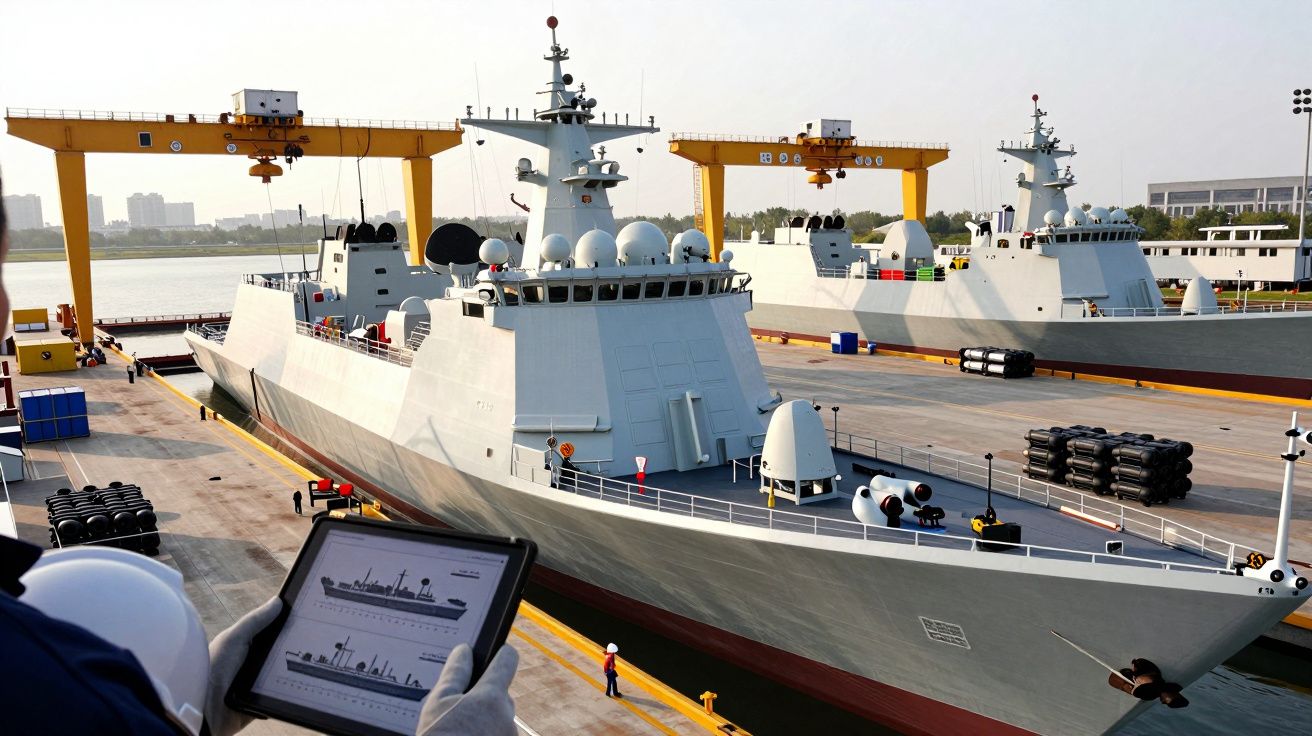
On New Year’s Day, as the rest of the world nursed hangovers and watched fireworks, the Navy of the People’s Liberation Army quietly brought a new combatant into service: the destroyer Loudi, hull number 176. It looks like just another grey hull, yet it embodies a shift that is starting to unsettle planners in Washington, London and Tokyo.
More than a single ship: what Loudi really signals
Loudi is one of the newest members of the Type 052D class, known in NATO reporting as the Luyang III destroyer. The first of the line joined the fleet in 2014. Since then, Beijing has stuck firmly to a simple formula: build one main design in large numbers, tweak it gradually, and keep the yards busy.
Each ship displaces around 7,500 tonnes fully loaded and can make close to 30 knots, roughly 55 km/h. That speed and size tell you what these vessels are for. They are blue-water warships, built for long deployments, high-tempo operations and distant escorts, not for hugging the shoreline.
Rather than chasing a “perfect” one-off design, China has chosen a good-enough hull and is multiplying it at industrial speed.
Type 052D destroyers sail with carrier groups, guard amphibious task forces and provide long‑range fire support. The new Loudi slips easily into that pattern: another node in a growing, relatively homogenous fleet.
Missiles first: a 64-cell punch from sea to land
A vertical launcher that defines the ship
At the core of the Type 052D’s combat power is its vertical launch system. Loudi carries 64 launch cells, split between the bow and the stern. For a ship this size, that is a serious weapons load.
Those cells can be packed with different missile types:
- HHQ‑9B long‑range surface‑to‑air missiles to hit aircraft and cruise missiles
- YJ‑18 anti‑ship missiles designed to threaten enemy surface combatants
- CJ‑10 land‑attack cruise missiles capable of striking targets far inland
This mix allows commanders to tailor the load for each mission. The same hull can defend a formation against air raids, threaten enemy destroyers, or launch precision strikes ashore.
A single Type 052D can shield a task group from air attack while holding targets hundreds of kilometres inland at risk.
That flexibility is exactly what modern navies pay for when they invest in large destroyers: one platform, many roles, and quick shifts between them as the situation changes.
New mast, new brain: radar that reshapes the ship
A redesigned mast with a purpose
Footage from Chinese state television shows that Loudi’s mast is not the same as earlier ships of the class. It looks bulkier and cleaner, with fewer exposed structures and a more integrated radar suite.
Chinese analysts, quoted in state media, suggest this is a dual‑face rotating active electronically scanned array (AESA) radar. That kind of system can track many more targets, refresh data quickly and resist jamming more effectively than older sets.
The radar upgrade is not cosmetic; it is a direct answer to massed missile and drone attacks that modern navies now have to plan for.
In a scenario where dozens of incoming weapons arrive almost simultaneously from different directions, sensor performance becomes as critical as the missiles themselves. A destroyer that sees late, shoots late. One that sees early can co‑ordinate the entire group’s response.
From shooter to conductor: command hub at sea
Loudi is not just a muscle-bound “shooter” stuffed with missiles. Statements from its crew highlight a stronger role in commanding other ships. That includes fusing data from multiple sensors, sharing a common tactical picture and assigning targets across the formation.
The idea is simple. Instead of each ship acting on its own radar feeds, the Type 052D can centralise information, then pass orders back out to escorts and smaller vessels.
Think of the destroyer less as one more player, and more as the on‑field captain directing the rest of the team.
This approach fits a navy that trains to fight in layered formations: overlapping bubbles of air defence, anti‑submarine screens and shared strike options. It also matches China’s broader interest in networking its forces across long distances.
Guns, helos and the last line of defence
Close-range tools still matter
Like other modern destroyers, Loudi carries more than just missiles. A 130 mm main gun on the bow offers naval gunfire support for troops ashore and a cheaper option against small surface targets.
Close‑in weapon systems and short‑range missiles handle the “last miles” when incoming threats slip through the outer layers. On the aft deck, a hangar and flight deck support at least one helicopter, vital for hunting submarines and extending surveillance beyond the ship’s radar horizon.
Sonars, electronic warfare suites and an array of other sensors round out the package. The result is a clearly multi‑mission ship: effective on its own, but designed to be even more potent inside a task group.
The real advantage: production at a relentless pace
Two to three destroyers per year
The most striking feature of the Type 052D story is not any one technical detail. It is the rhythm. Chinese shipyards have already built more than thirty of these destroyers, and they are launching two to three each year in this general category of vessel.
| Destroyer type | Approx. displacement | Primary role | Recent production pace |
|---|---|---|---|
| China Type 052D | ~7,500 t | Multi‑role | 2–3 per year |
| US Arleigh Burke | ~9,000+ t | Multi‑role | Roughly 1 per year |
| UK Type 45 | ~8,000 t | Air defence | Class complete, 6 built |
| Franco‑Italian Horizon | ~7,000 t | Air defence | Class complete, 4 built |
Western navies, by contrast, tend to build small batches of very expensive ships, over long timelines, with frequent design resets. China has opted for scale and steady iteration. Each new hull brings minor tweaks, such as the revised radar on Loudi, without halting the production line.
The Type 052D might not beat every rival on paper, but taken as a fleet, the class packs weight simply by its numbers.
In a long crisis or conflict, this matters. A navy with dozens of similar destroyers can absorb losses, rotate crews, and keep formations at sea for extended periods. Logistics also benefit: training, spare parts and maintenance routines are easier with a highly standardised design.
How it stacks up against Western and Asian peers
Compared with the Royal Navy’s Type 45 destroyer, the 052D is less specialised. The Type 45 is almost entirely focused on air defence, with very limited strike capacity against land targets. The Chinese ship trades some of that narrow excellence for broader versatility.
Against America’s Arleigh Burke class, the picture flips. The US design is bigger and deeply integrated with the Aegis combat system and the broader US network. It fields more launch cells and is combat‑proven in multiple theatres. Yet the 052D comes closer in capability than many would have expected a decade ago, and it is being produced at a comparable or faster rate.
When placed beside European Horizon destroyers, which excel at area air defence but carry fewer strike weapons, the Chinese hull again looks more balanced between anti‑air, anti‑ship and land attack. Asian neighbours like South Korea and Japan are building high‑end destroyers too, but not yet at China’s sustained pace.
Why quantity plus quality reshapes naval risk
Military planners often talk about “mass” and “capability”. Mass is how many platforms you have. Capability is what each one can do. Traditionally, Western navies have prioritised capability, accepting small fleets of extremely advanced ships.
The Type 052D challenges that model by delivering a decent level of capability at a scale that is hard to match. A single destroyer is dangerous; thirty with shared systems, shared training and overlapping deployment cycles start to change the regional balance.
For countries operating in the Western Pacific, this raises practical questions. Convoys, amphibious groups and even carrier strike groups must account for the likelihood of facing not one or two top‑tier adversary ships, but multiple modern destroyers able to co‑ordinate their sensors and firepower.
Key concepts behind the numbers
Two technical ideas sit quietly behind the Type 052D’s growing influence. The first is the “vertical launch system” or VLS. Instead of loading missiles in angled launchers, ships store them in vertical tubes embedded in the deck. This arrangement saves space and allows the crew to load different missile types into the same grid of cells. It turns the ship’s fore and aft decks into modular weapon farms.
The second is “area air defence”. Rather than only protecting itself at close range, a destroyer like Loudi can create a protective bubble around many ships. Its long‑range missiles and powerful radar give it the reach to shoot down threats while they are still far away, defending vulnerable tankers, amphibious ships and logistics vessels.
Both ideas scale with numbers. The more VLS cells a navy fields across its fleet, the more missiles it can bring to a fight. The more area‑defence destroyers it has, the more task groups it can shield at once. This is where China’s fast production of Type 052Ds starts to weigh heavily in war games.
What this could mean in future crises
Imagine a standoff around Taiwan, or a confrontation in the South China Sea. Chinese planners could assign multiple Type 052Ds to screen carriers, escort amphibious forces and sit forward as “pickets” feeding radar data back to the fleet. Long‑range missiles from these ships would complicate the approach of US or allied vessels, even if those forces remain technologically ahead in some areas.
There are trade‑offs for Beijing: sustaining a big, modern fleet is expensive, and operating high‑end destroyers far from home brings its own strain. Yet the direction of travel is clear. With each new hull like Loudi sliding down the ways, China is not just adding one more ship. It is reinforcing an industrial and operational model that values continuity, numbers and iterative improvement, and that model is starting to reshape the maritime balance in Asia and beyond.





Comentários
Ainda não há comentários. Seja o primeiro!
Deixar um comentário